In real estate, "location, location, location" is an old adage that has never been truer. What has changed is how businesses exploit that location data — from merely displaying a pin on a map to building an entire layer of spatial analysis that helps customers make faster decisions and operational teams work more efficiently. This article delves into 6 specific problems faced by real estate agencies, proptech startups, and project development teams — and how a localized map API can solve each problem practically.
Vietnamese real estate addresses have a unique characteristic: they are often not addresses in the conventional sense. Instead of "No. 15, Nguyen Van A Street, Ward B, District C," customers and agents often use project names, residential area names, or folk location descriptions: "Corner unit, Block A, Vinhomes Grand Park," "Land lot fronting a 12m road, expanded Tan Tao residential area," "Townhouse adjacent to Sala urban area, Thu Thiem."
With international geocoding APIs, these address strings often return inaccurate results or cannot be found. The consequence: the real estate website displays the map pin in the wrong location, the home search app cannot filter by actual area, and the agent team has to manually enter coordinates for each listing.
Furthermore, the 2024–2025 wave of administrative mergers has changed the ward/district names of thousands of projects currently for sale. An apartment that once belonged to "District 2" now belongs to "Thu Duc City" — but in the databases of many real estate agencies, the old address remains, causing confusion for both customers and internal search systems. When a customer filters for "houses in Thu Duc City," an old listing labeled "District 2" does not appear — even though it's the exact same apartment.
Actual data: A real estate agency in Ho Chi Minh City with 15,000 listings estimates that about 23% of its listings have coordinates that deviate by more than 200m from the actual location — enough for the map pin to fall into a different area, wrong ward, or even wrong district after a merger. For a customer looking for a house near their child's school, a 200m error can be the difference between "in the school zone" and "outside the school zone."
The MapVina Geocoding API is trained on actual address data across 63 provinces and cities, understanding popular project names, residential areas, and even folk place names. More importantly, the API supports processing old and new addresses in parallel — allowing real estate agencies to standardize their entire listing database without having to manually re-enter each row.
"Is it near a school?" — this is a question any real estate agent hears at least a few times a day. Along with: "Is there a market nearby?", "How long does it take to get to the hospital?", "Is there a metro station?", "Does this area flood?"
Answering these questions manually — opening a map, searching for each type of amenity, measuring distances, taking screenshots to send to the customer — takes an average of 8–12 minutes each time. For an agent handling 20–30 customers simultaneously, this is a significant amount of time. Multiply that by a team of 50 agents, each answering 5 amenity questions a day, and the business is consuming about 35–50 staff hours daily just to do work that a system can completely automate.
With the MapVina Search API and Places API, this problem can be solved right on the listing page. When a customer views an apartment on the website, the system automatically calls the API to find amenities within a radius of 500m, 1km, 2km: schools (categorized by primary/secondary/high school), hospitals, markets, supermarkets, metro/bus stations, and parks. The results are displayed immediately on the listing page as a list or a map layer — no agent intervention required, no need for the customer to ask.
Measured results: A proptech startup in Hanoi integrated a "Nearby Amenities" feature into its listing pages. After 3 months, the average time customers spent on the page increased by 34%, and the lead conversion rate increased by 18%. The reason is simple: customers have enough information to make preliminary decisions themselves, instead of having to message the agent and wait for an answer.
A common mistake on real estate websites is filtering results by straight-line radius: "apartments within 5km from the center," "houses within a 3km radius from schools," "offices 10km from the airport." It sounds reasonable, but in Vietnam, the straight-line distance often does not reflect the actual travel experience.
An apartment 4km from the office might take 35–45 minutes if you have to cross the Kenh Te Bridge during rush hour. Meanwhile, an apartment 7km away but straight down the Pham Van Dong axis might only take 20 minutes. For homebuyers, what they care about is not "how many kilometers," but "how long it takes to get to work every morning," "can I pick up the kids on time," "is it too far to go to the hospital if needed."
This is where the Routing API makes a big difference. Instead of just displaying distances, the system can calculate the actual travel time from the real estate to the customer's important points: workplace, children's school, parents' house, hospital. When customers enter 2–3 familiar locations, the website automatically scores each listing based on travel times that fit their lifestyle.
Product perspective: A filter for "less than a 25-minute commute to the office" is usually much more useful than "less than 5km from the office." It transforms the home search experience from viewing hundreds of identical apartments into a personalized list based on each family's real life.
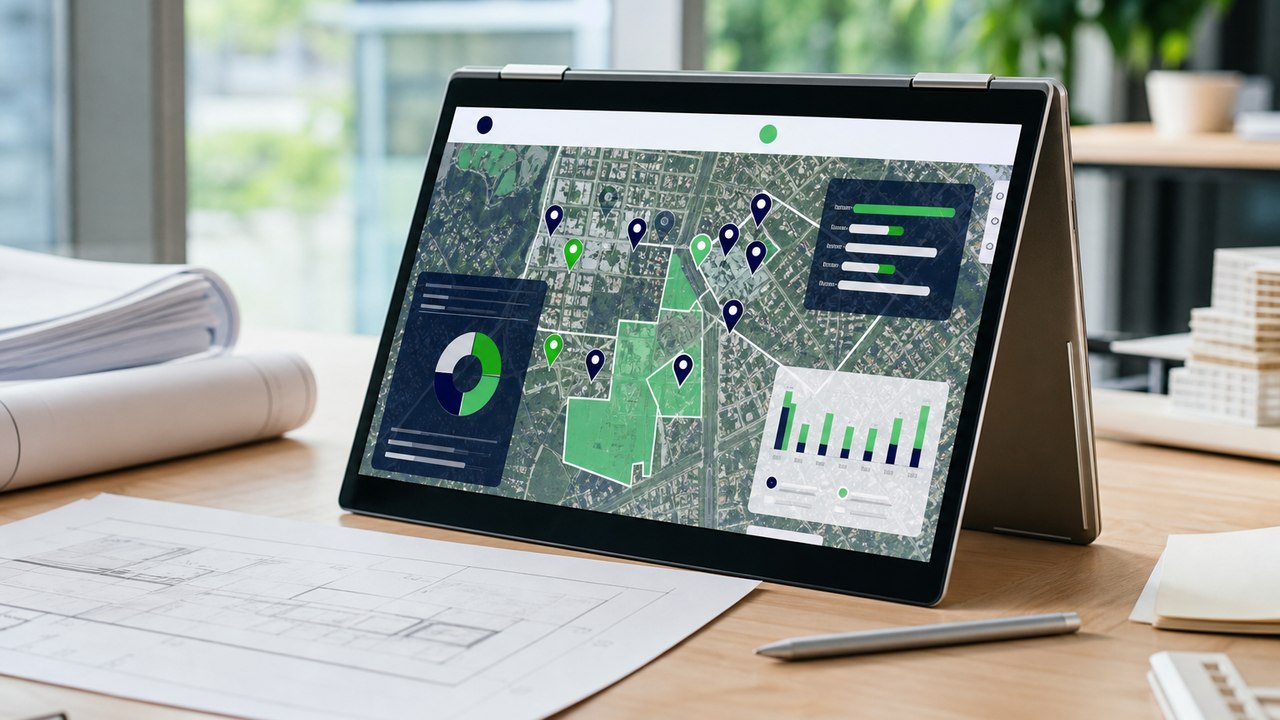
At a higher level, map APIs do not just help display individual houses; they also help businesses understand the market by region. A real estate agency with 50,000 monthly searches holds a very valuable treasure trove of data: where customers are searching, what price ranges they filter, what property types they care about, which areas have high views but few listings, and which areas have many listings but few inquiries.
If this data only resides in spreadsheets, it is very difficult for the sales team to spot trends. But when plotted on a map as a heatmap, the story becomes much clearer: which district has an increasing demand for small office rentals, which metro line is driving apartment searches, which area has high asking prices but low lead conversion rates, and which area has real demand but insufficient supply.
CFO perspective: If a real estate advertising campaign spends 300 million VND/month but is not segmented by areas with real demand, 20–30% of the budget might be burning in areas with low conversion potential. When search data, leads, and listings are mapped, the business has a basis to cut underperforming areas and increase the budget for areas with clearer buying/renting signals.
In real estate, a lead is only truly valuable when the customer agrees to go see the house. But from the moment a customer clicks "book a viewing" until they actually arrive at the project is a whole chain of minor risks: the customer cannot find the entrance, goes to the wrong block, the driver stops at the back of the project, or the agent has to call multiple times to give directions.
With apartment complexes, the overall coordinates of the project are not enough. A large project may have multiple gates, multiple blocks, and multiple entrances for guests and residents. If the map only pins the center of the plot, customers can still spend 10–15 minutes walking around. With townhouses in alleys, one wrong turn means the customer has to turn back, call the agent again, and their initial excitement diminishes very quickly.
The MapVina API can help businesses generate precise navigation links to the exact meeting point: Block A entrance, the reception lobby, guest parking, or the alley entrance where the agent is waiting. When a viewing appointment is created, the system automatically sends the customer a map link with clear notes. It's a minor detail, but it makes the experience much more professional.
Operational impact: If each property viewing saves 5 minutes of phone calls for directions, a team of 30 agents with 300 viewings/month saves about 25 hours of repetitive communication. More importantly, customers arrive at the right place, on time, in a less frustrated mood — and that directly impacts the quality of the consultation session.
Many proptech businesses start with beautiful interfaces and modern filters. But after a few years of operation, the biggest problem usually lies in the underlying data: the same project has 3 different names, the same ward has an old and new name, one listing has coordinates while another only has a text address.
When location data is not standardized, the entire upper system is affected: inaccurate searches, wrong recommendations, flawed reports, and misallocated leads. The more features the tech team builds, the larger the data debt becomes. At some point, the business doesn't know if the problem is the algorithm, agent input errors, or the initial address data.
A localized map API can act as a central standardization layer: converting addresses to coordinates, cross-referencing project names, identifying old/new addresses, mapping listings to the correct current ward/district, and flagging records with low confidence. Instead of letting each department handle data their own way, the business has a unified location standard for the entire system.
Crucial lesson: In digital real estate, location data is not an auxiliary part. It is the foundation. A listing pinned in the wrong location will make customers lose trust. A wrongly zoned dashboard will cause leaders to make wrong decisions. A modern CRM with non-standard addresses will waste the sales team's time every day.
Map APIs, if used correctly, do more than just give a real estate website "a map." They help the business better understand each asset, each area, each search behavior, and each customer's property viewing journey. From that silent data layer, business decisions become less emotional: where to expand, which listings to prioritize, where to run ads, and how to allocate agents.
In the Vietnamese real estate market — where addresses change with administrative updates, residential area names are often more common than legal names, and customers decide based on everyday feelings like "near the kids' school" or "will I hit traffic going to work" — a mapping system that understands the local context will create a very clear advantage.
If your business is building a real estate website, a proptech platform, or an internal listing management system, start by standardizing your location data. When the data foundation is solid, the features built on top — search, recommendations, analysis, navigation, reporting — will truly deliver value.
Chat with MapVina to discuss location data problems in real estate, or explore the API documentation to start integrating.
Moving this industry forward requires not only skill, talent and expertise, but also imagination. All are welcome.